
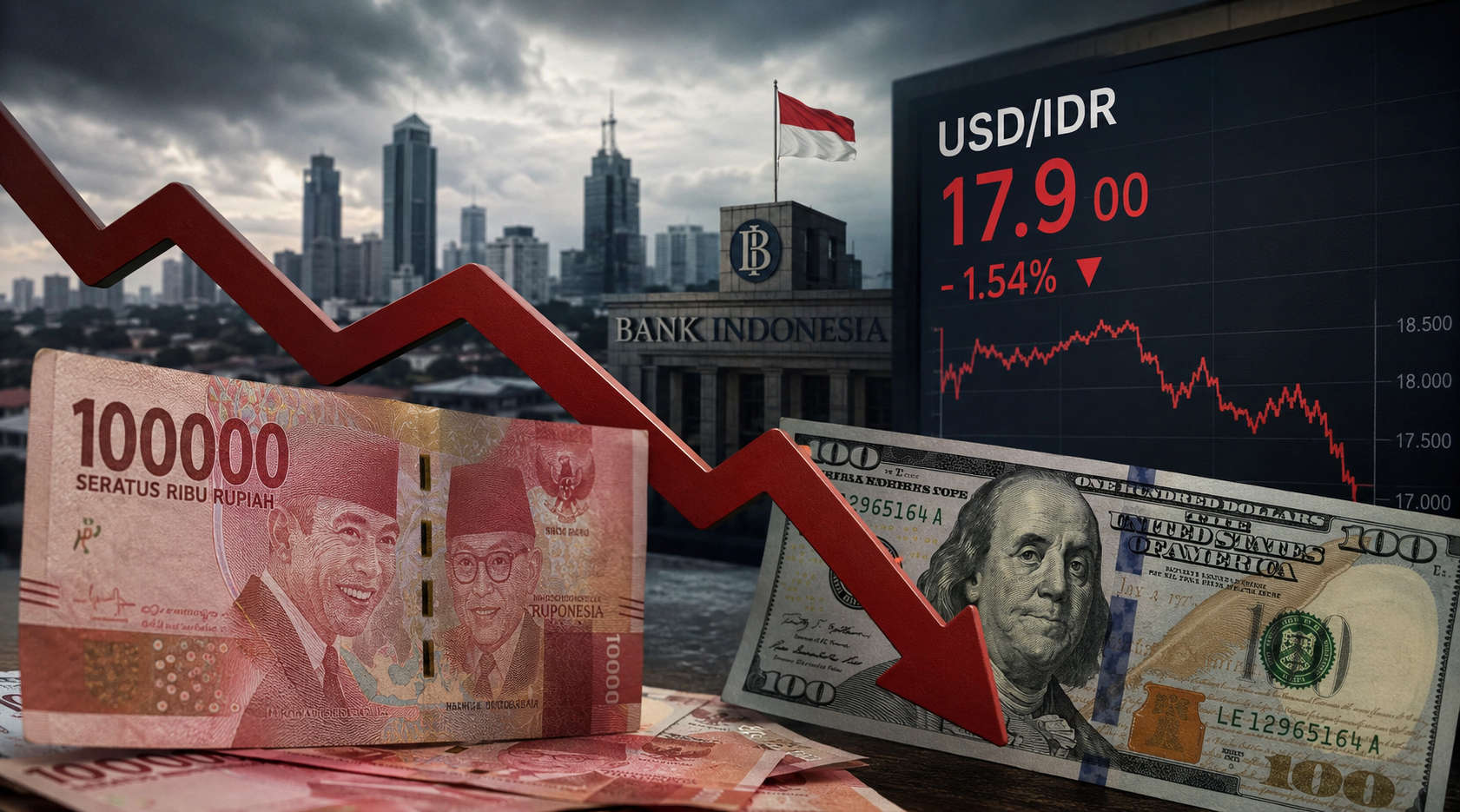
rayantara.com – Whenever the Indonesian rupiah weakens against the United States dollar, public concern quickly follows. For many Indonesians, a weakening rupiah is often perceived as a sign of economic trouble. Others have become so accustomed to the phenomenon that it no longer comes as a surprise.
Yet the more interesting question is not simply “Why is the rupiah weakening?” but rather “Why does the rupiah appear to weaken over the long term?” Furthermore, why have many people begun to believe they can predict market reactions to major government announcements and political decisions?
These questions highlight an important reality: exchange rates are not driven by economics alone. Behind every movement in the rupiah lies a complex interaction of economic fundamentals, political developments, investor psychology, and market confidence.
A Pattern That Appears Repeatedly
Looking at Indonesia’s economic history, the rupiah has indeed shown a long-term depreciation trend against the U.S. dollar.
Before the Asian Financial Crisis of 1997–1998, one U.S. dollar was worth approximately IDR 2,500. Following the crisis, the rupiah plunged beyond IDR 15,000 per dollar. Although it later recovered, it never returned to its pre-crisis level.
A similar pattern has appeared during subsequent economic shocks. Whenever major disruptions occur, the rupiah often recovers partially but rarely returns to its previous position. Over time, this creates a staircase-like pattern: a sharp decline during crises, followed by partial recovery, but ultimately settling at a weaker level than before.
This recurring trend has led many observers to question whether rupiah depreciation is simply an unavoidable reality.
Is the Rupiah Weak, or Is the Dollar Exceptionally Strong?
Public discussions often focus entirely on the rupiah. However, another important perspective deserves attention: the extraordinary strength of the U.S. dollar itself.
The dollar remains the world’s primary reserve currency. Most international trade transactions, commodity pricing, and central bank reserves continue to rely on the U.S. dollar. During periods of global uncertainty, investors tend to move their capital toward dollar-denominated assets because they are perceived as safer.
As a result, the rupiah is not alone. Many emerging-market currencies experience similar pressure against the dollar during the same periods.
From this perspective, part of the rupiah’s depreciation may reflect not only domestic challenges but also the overwhelming dominance of the dollar within the global financial system.

Inflation and Long-Term Economic Reality
Another factor that often receives less attention is the inflation differential between Indonesia and the United States.
Economic theory suggests that countries with persistently higher inflation rates tend to experience currency depreciation over time. For decades, Indonesia’s average inflation rate has generally remained above that of the United States.
While the annual difference may appear modest, the cumulative effect over many years can significantly influence exchange rates.
Consequently, a portion of the rupiah’s long-term depreciation may represent a normal economic adjustment rather than a direct indication of policy failure.
Dependence on Foreign Capital
Indonesia’s financial markets are also highly sensitive to global capital flows.
When international investors view Indonesia favorably, foreign funds enter domestic stock and bond markets. Increased demand for rupiah-denominated assets can strengthen the currency.
However, when U.S. interest rates rise or global uncertainty increases, investors often shift their capital back toward safer assets. This capital outflow places downward pressure on the rupiah.
As a result, Indonesia’s exchange rate is influenced not only by domestic conditions but also by decisions made in financial centers far beyond its borders.

Commodities Remain a Key Supporting Factor
As a resource-rich nation, Indonesia remains closely tied to global commodity cycles.
When prices of coal, nickel, palm oil, and other major exports increase, foreign exchange earnings rise and provide support for the rupiah.
Conversely, when commodity prices decline, pressure on the currency often intensifies.
This reality demonstrates that the strength of the rupiah continues to be influenced by external market conditions that Indonesia cannot fully control.
Politics and Market Confidence
Beyond economics, there is another factor that is more difficult to quantify yet highly influential: market confidence in government policies and leadership.
Financial markets do not react solely to current economic conditions. Investors continuously attempt to forecast future developments.
When policies are perceived as creating fiscal risks, regulatory uncertainty, or concerns about long-term economic management, markets may react even before the actual consequences become visible.
In modern financial systems, perception can be nearly as powerful as reality.
When confidence rises, investment flows in and markets strengthen.
When confidence declines, capital leaves and markets weaken.
This is where politics and economics become deeply interconnected.

A Phenomenon Increasingly Noticed by the Public
One particularly interesting phenomenon in recent years is the growing public perception that major government announcements, policy initiatives, or political speeches are often followed by market volatility.
Of course, such perceptions cannot automatically be treated as scientific conclusions without rigorous analysis.
Nevertheless, the emergence of these beliefs reveals something important: confidence itself has become a significant economic variable.
When people jokingly predict that the stock market will fall after certain speeches or that the rupiah will weaken following specific announcements, they are expressing more than humor.
They are reflecting concerns about expectations and trust.
In many cases, markets do not wait for policies to produce measurable results. Markets react to expectations about what those policies may bring in the future.
Is the Government Entirely Responsible?
The answer is no.
Blaming the government as the sole cause of rupiah depreciation would be an oversimplification. Global factors such as U.S. monetary policy, geopolitical tensions, international capital flows, and worldwide economic uncertainty continue to exert significant influence on emerging-market currencies.
At the same time, dismissing domestic factors would be equally misleading.
Investor confidence in policy consistency, regulatory certainty, institutional credibility, fiscal discipline, and long-term economic strategy can all influence investment decisions and, ultimately, exchange rate performance.
In other words, the rupiah’s movement cannot be explained solely by global pressures or solely by domestic politics. It is the interaction between both that shapes market behavior.
Conclusion
The weakening of the rupiah is not the result of a single factor. It reflects a combination of dollar dominance, long-term inflation differences, dependence on foreign capital, commodity market fluctuations, and investor confidence in government policies.
Ultimately, the rupiah is more than just an exchange rate. It serves as a reflection of how investors perceive Indonesia’s future.
Perhaps the more important question is not:
“Why is the rupiah weakening?”
but rather:
“Can Indonesia build sufficient confidence to remain attractive and resilient, even in an increasingly uncertain global environment?”
In today’s interconnected financial world, confidence may be just as valuable as foreign exchange reserves, natural resources, or economic growth itself.
Read Also : Pencopotan Kepala BGN: Evaluasi Kepemimpinan dan Arah Baru Program MBG
Writer : Muhammad Nur Imam


